.png?width=575&name=Screenshot%202025-08-28%20at%209.19.53%20AM%20(1).png)
From SEO to AEO (Answer Engine Optimization)
A Practical Guide for CMOs, Marketing Leaders & HubSpot Teams
How AI Is Rewriting Search, Funnels, and the Role of Content
SEO hasn’t “died.” It’s evolved.
AI is changing how people discover, evaluate, and choose vendors. Your prospects now ask questions to ChatGPT, Perplexity, Gemini, and Claude the way they used to query Google. These AI tools don’t just return links; they return answers, often summarizing the web and only occasionally sending users to a website.
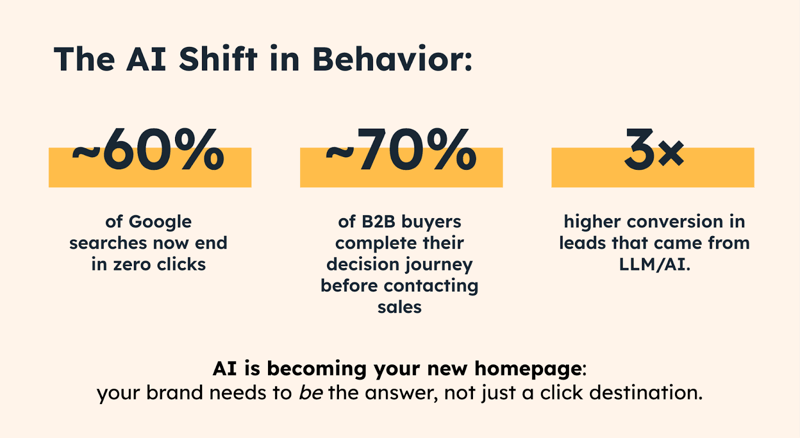
That shift is creating three simultaneous realities:
2. Buyers are further along in their decision process by the time they talk to sales
3. Leads coming from AI-powered discovery tend to be fewer in volume, but higher in intent (Source: HubSpot’s State of AI Report)
This guide is for CMOs, marketing leaders, SEO/content teams, and HubSpot users who are feeling that shift, fewer leads, longer sales cycles, but surprisingly strong opportunities coming “out of nowhere” from AI referrals.
We’ll walk through:
2. How AI is reshaping the funnel and creating AI-qualified buyers
3. How to use entities, schema, and structured content to become the answer in AI
4. How to build a Loop Marketing Framework and Content Engine Loop that feeds humans, Google, and AI models
5. How HubSpot’s AEO tools, Copilot, and Agents can operationalize all of this
6. A 30-day starter plan you can actually execute
You don’t need to burn SEO down and rebuild from scratch. But lazy SEO, thin content, keyword stuffing, and “publish and hope”, is over. What wins now is answer-driven, entity-rich, human authentic content, distributed through modern loops and supported by smart AI tooling.
How AI Is Changing Search and Organic Traffic
Zero-click search and disappearing blog traffic
For years, SEO teams could rely on a simple equation:
More rankings → more traffic → more leads → more deals.
That equation is breaking.
Multiple studies have found that the majority of Google searches now result in no click at all, because answers appear directly on the SERP through featured snippets, knowledge panels, and AI-generated overviews. One widely cited analysis found that about 58–65% of searches end without a click to any website. (Source: Search Engine Land)
At the same time, 57–70% of the B2B buyer’s journey is complete before buyers ever talk to sales, as they self-educate through search, third-party sites, and peer content. (Source: 6sense)
AI is amplifying both trends. Tools like ChatGPT, Perplexity, and Gemini increasingly act as an answer layer on top of the web, summarizing multiple sources into one response.
The result:
1. You may see stable or even rising impressions, but fewer clicks2. Buyers arrive in your pipeline better informed and sometimes more opinionated
3. Some of your organic traffic is now being sent to AI tools that don’t always return a visit to your site.
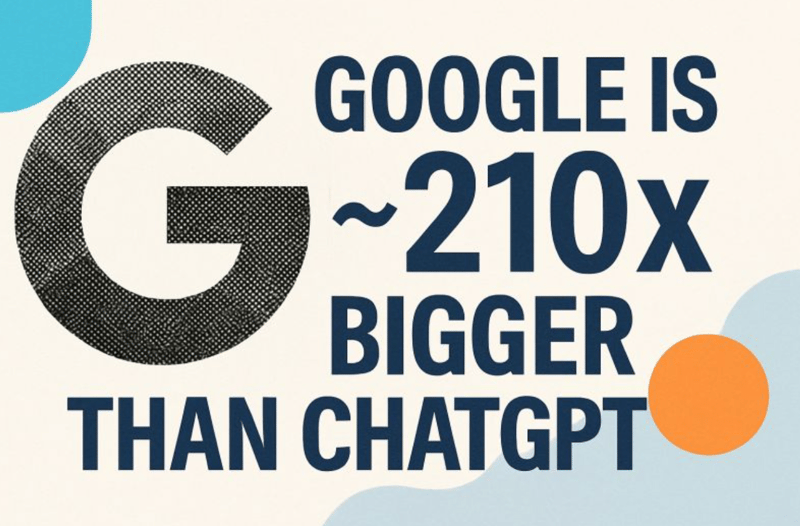
At the same time, Google is still 210 times larger than ChatGPT in search, so continuing to invest in strong SEO remains important and benefits both platforms. (Source: Search Engine Land)
AI is the new homepage
HubSpot’s own AEO research describes AI tools as a new “front door” for discovery: instead of landing first on your homepage, users often land on an AI answer that mentions you or summarizes your content. (Source: HubSpot)
This has big implications:
1. Your brand needs to show up as the recommended solution inside AI answers2. Your content needs to be structured in ways that AI models can easily understand, reuse, and cite
3. Your site is still crucial, but more as a destination for already-curious, AI-qualified visitors
In other words, SEO is no longer just about getting the click. It’s about becoming the source AI relies on to give the right answer.
Related Article: From SEO to AEO (Answer Engine Optimization): How AI is Redefining Client Acquisition
How AI Is Changing the Marketing and Sales Funnel
The old funnel vs. the AI-era funnel
The “old” inbound + SEO funnel looked like this:
1. Rank on Google for a broad range of keywords2. Generate as much traffic as possible
3. Convert a small percentage into leads via forms/gates
4. Nurture and qualify
5. Hand off a slice of those leads to sales
High volume, mixed intent, lots of nurturing and disqualification.
The AI-era funnel looks different:
1. Buyer researches extensively in AI tools and on the open web2. They compare vendors, pricing, risks, and alternatives, often with AI as their “research assistant”
3. AI surfaces a small shortlist of reputable, well-documented options
4. By the time they click to your site or fill out a form, they’re already deep into the problem-and-solution stage
What we’re seeing:
1. Fewer form fills and net-new MQLs from organic search2. Longer, more complicated sales cycles with more rescheduling, ghosting, and internal friction
3. Higher close rates and larger deal sizes from leads that originated or were heavily influenced by AI (“I found you in Perplexity,” “ChatGPT suggested you,” you were mentioned in a comparison answer”)
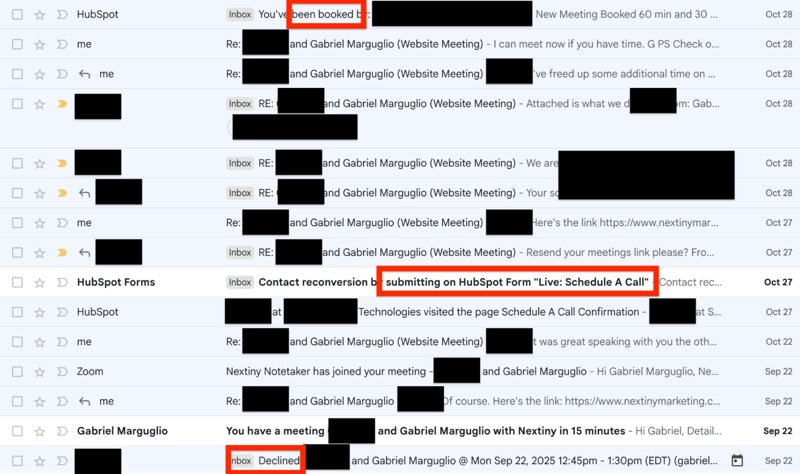
In one real HubSpot portal example:
- ~4,000 organic search visits produced 42 leads and 1 closed-won deal
- Just 90 AI referral visits (from ChatGPT, Perplexity, etc.) produced 2 leads — both sales opportunities — and 1 closed-won deal
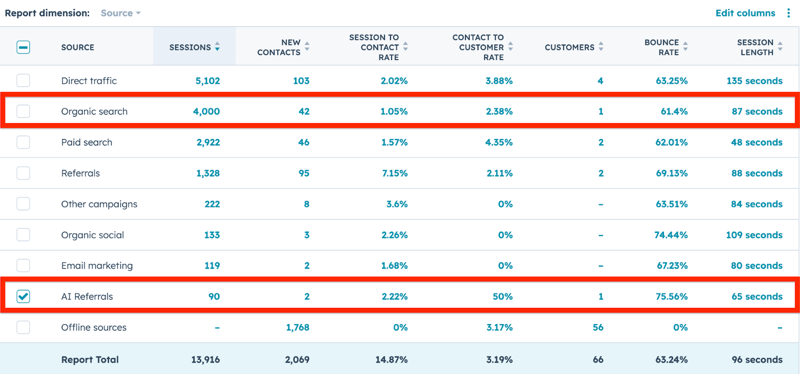
The raw numbers are small, but the pattern is clear:
- Traditional SEO: volume-heavy, intent-mixed
- AI referrals: volume-light, intent-strong
Hence the new mantra: fewer leads, bigger wins.
AI-qualified buyers
The AI-qualified buyer shows up differently:
1. They’ve already clarified their problem and possible approaches2. They’ve often compared you to competitors via AI prompts
3. They may be using AI to sanity-check your proposals or content
4. Their biggest questions are about fit, risk, and trust, not “what is this?“
The job of marketing and sales shifts from “educate from zero” to:
1. Confirm what they’ve learned2. Fill in gaps and correct misconceptions
3. Provide proof, clarity, and a safe path to commit
4. Be more human, more patient, and more consultative
To support that, your content and systems need to be optimized not only for Google, but for AI tools that are pre-qualifying and pre-educating your buyers. That’s what AEO is all about.
What Is AEO and How Is It Different From SEO?
What is Answer Engine Optimization (AEO)?
Answer Engine Optimization (AEO) is the practice of designing your content, site structure, and signals so that AI-powered systems can easily find, understand, and reuse your expertise in the answers they give to users.
SEO isn’t going away. In fact, good SEO is the foundation of effective AEO, since AI tools still depend on well-structured, credible content. But AEO adds new considerations on top.
SEO vs. AEO: Key differences
|
Focus Area |
Classic SEO |
AEO (Answer Engine Optimization) |
|
Primary goal |
Rank pages & earn clicks |
Be cited and reused in AI-generated answers |
|
Core unit |
Keywords & URLs |
Entities, questions, and structured answers |
|
Success metric |
Rankings, sessions, CTR |
Appearances in AI answers, AI referral traffic, assisted revenue |
|
Trust signals |
Backlinks, on-page SEO, UX |
Multi-channel signals: reviews, video, social proof, EEAT |
|
Content format |
Long-form articles, pillar/cluster models |
Conversational Q&A, FAQs, transcripts, multi-modal content |
|
Optimization target |
Google/Bing SERPs |
Google + AI tools (ChatGPT, Perplexity, Gemini, Claude) |
The key idea: everything you’ve done for good SEO still matters. Lazy SEO is what’s dead.
AEO asks you to:
1. Shift your focus from just “keywords” to entities and questions2. Make your content easier for machines to parse and reuse, via schema, structured sections, and clear FAQs
3. Strengthen your off-site credibility through video, social, and reviews
4. Make sure your brand narrative is consistent across channels so AI can infer who you are and what you’re known for
Why Are Entities Important for Answer Engine Optimization?
Why entities matter in an AI world
Keywords tell search engines what words are on the page. Entities tell them what those words actually mean in context.
“Apple” is a keyword. But “Apple Inc., the technology company” is an entity, distinct from “apple, the fruit.”
Entities include:
1. People (you, your founders, your subject-matter experts)2. Organizations (your company, partners, competitors)
3. Locations (cities, regions, service areas)
4. Products & services (named offerings, methodologies)
5. Industries & verticals you serve
6. Technologies, procedures, methodologies, and tools you specialize in
When AI tools build an answer, they’re effectively operating on a giant knowledge graph of entities and relationships, not just a bag of keywords.
If those tools can confidently connect:
Your company → your expertise → the tools you use → the outcomes you deliver → and the proof behind them
You stand a much better chance of being cited.
Practical entity moves you can make
You don’t need a PhD in knowledge graphs to start using entities. Start by:
1. Nailing your NAP everywhere- Ensure your Name, Address, and Phone number are consistent across your website footer, Google Business Profile, LinkedIn, review sites, and directories. This is basic local/organization schema fuel and just good old “Local SEO”
2. Clarifying who’s who on your site
- Give authors real bios, headshots, and links to their social profiles
- Connect author pages to the blogs and topics they cover
- Mention your company name, industry, and key services in context, not just once in the footer
3. Writing entity-rich copy
- Don’t just say “we help companies grow.” Say “Nextiny is a HubSpot Platinum Solutions Partner that helps B2B and B2C organizations in healthcare, SaaS, construction, franchise, nonprofit and service-based industries grow through SEO/AEO, HubSpot websites, content engines, and full HubSpot implementation.”
4. Using schema to label what’s what
- Use schema types like Organization, LocalBusiness, Person, Article, FAQPage, and VideoObject to give AI explicit signals about the entities on the page. The next section explores this in more detail.
How Do Schema, Structured Data, and FAQs Help With AEO?
Why structured data matters
Humans can skim a page and figure out what’s going on. AI tools and search engines rely heavily on structure to understand:
1. What question is being answered2. Which paragraph actually is the answer
3. Which parts are examples, caveats, FAQs, or calls-to-action
Schema and structured data are bits of code that “label” those elements on your page for machines.
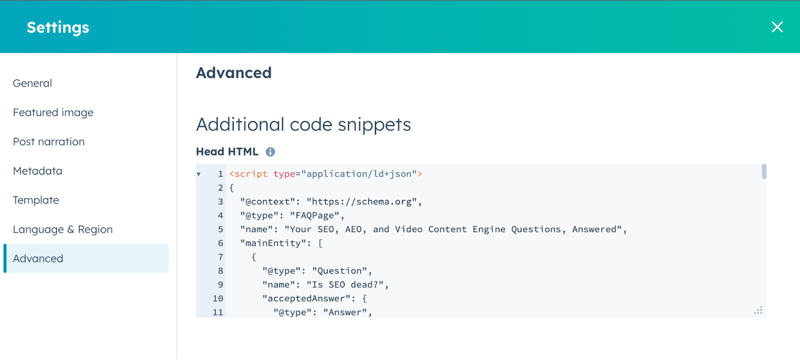
There are various schema types, and the following are especially valuable for AEO:
2. Article / BlogPosting for blogs and guides
3. VideoObject for embedded videos and webinars
4. Person for authors, speakers, and experts
5. Organization / LocalBusiness for your company
6. How To for step-by-step guides
FAQs: Small change, Big impact
One of the simplest AEO wins is adding a short FAQ section to the bottom of your most important pages and posts and tagging it with FAQPage schema.
Adding FAQs gives AI clear, structured answers to pull from, which increases your chances of being cited in AI responses and improves zero-click visibility.
Good FAQ practices:
1. Use real questions your sales and support teams hear (Think: They Ask, You Answer)2. Phrase questions naturally, the way someone would type or say them
3. Keep answers short (2–4 sentences) and direct
4. Avoid turning FAQs into mini-blog posts (that’s what the main content is for)
You can use AI (including HubSpot’s AI tools) to generate FAQ schema from your written Q&A so your dev team doesn’t have to hand-code it.
How Do They Ask, You Answer and StoryBrand Support AEO?
AEO is not a new strategy. It sits on top of proven marketing and content frameworks.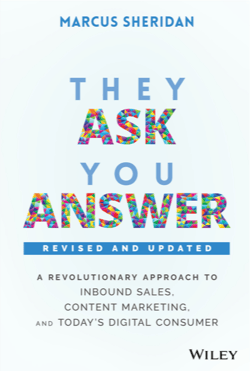 They Ask, You Answer (TAYA) is simple but powerful: Document and answer every meaningful question your ideal buyers ask, especially the ones competitors are afraid to touch.
The “Big 5” topics TAYA emphasizes:
1. Cost and pricing2. Problems and drawbacks
3. Versus and comparisons (your solution vs. alternatives)
4. Best of / “top” lists
5. Reviews and case stories
These topics happen to be exactly the sort of queries buyers now take to AI tools. When your site becomes the best, clearest source on these questions, AI engines have a reason to reference you.
Related Article: Boost SEO with 'They Ask You Answer' and HubSpot
StoryBrand: clarity over cleverness
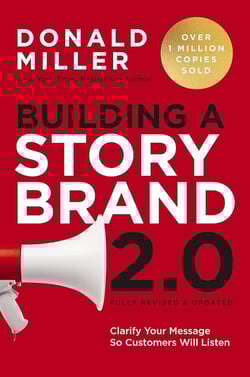 StoryBrand helps you frame your messaging and your ICP so that:
2. You are the guide with a clear plan
3. You speak to their pain, not your product features
4. You show what success looks like, and what’s at stake if they don’t act
This kind of narrative clarity is invaluable for AEO:
1. It sharpens the entities and promises you want associated with your brand2. It makes it easier for AI tools to infer “this company helps this type of buyer achieve these outcomes with this approach”
Related Article: What is StoryBrand Website Design? -HubSpot Content Hub Home Page Optimization
When you blend TAYA and StoryBrand, you get content that:
1. Answers your ideal clients’ real questions2. Speaks from a clear, empathetic perspective
3. Guides them toward simple, compelling next steps
That’s as good for humans as it is for AI.
Why Do Brand Authority and Authenticity Matter for AEO?
Beyond awareness: brand affinity marketing
Brand Affinity Marketing, popularized by Wistia, focuses less on one-off campaigns and more on:
1. Creating series (webinar shows, podcasts, recurring content)2. Building an audience that spends significant time with your content
3. Earning not just awareness, but affinity; genuine liking and trust
In an AI-saturated world where text can be fake and generic content is everywhere, affinity and trust matter more than ever.
Signals that contribute to both brand affinity and AEO:
1. Viewers consistently watching your videos/webinars to the end2. Subscribers returning for each new episode or session
3. Social sharing and discussion of your content
4. Customers, partners, and employees citing your content in their own posts
These human signals often correlate with the machine signals AI and search engines look for: mentions, links, embeds, brand search volume, and engagement.
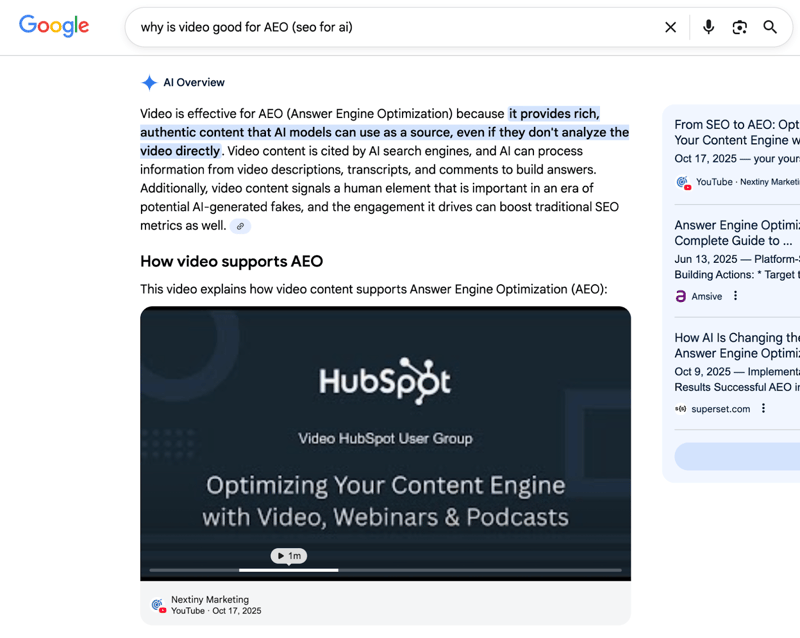
Example of Video as the AI answer
Authenticity: your unfair advantage
AI has made it trivial to:
1. Generate plausible blog posts2. Fake stock-style images and even faces
3. Auto-reply to comments and messages
As a result, authenticity becomes a differentiator:
1. Real faces, voices, and stories2. Real customer examples and data
3. Real “this didn’t work at first” honesty
AI tools are increasingly tuned to reward Experience, Expertise, Authoritativeness, and Trustworthiness (EEAT) — the same criteria Google has long emphasized for quality content.
That means the most powerful thing you can do for AEO isn’t to “sound like AI.” It’s to prove you are a real, experienced practitioner and to package that reality in formats AI can understand. Video, webinars, internal trainings, and even recorded client calls (ethically anonymized) are all gold for this.
Related Guide: Creating a Video Series for Brand Affinity
How Can You Build an AEO Strategy With Loop Marketing?
(Express → Tailor → Amplify → Evolve)
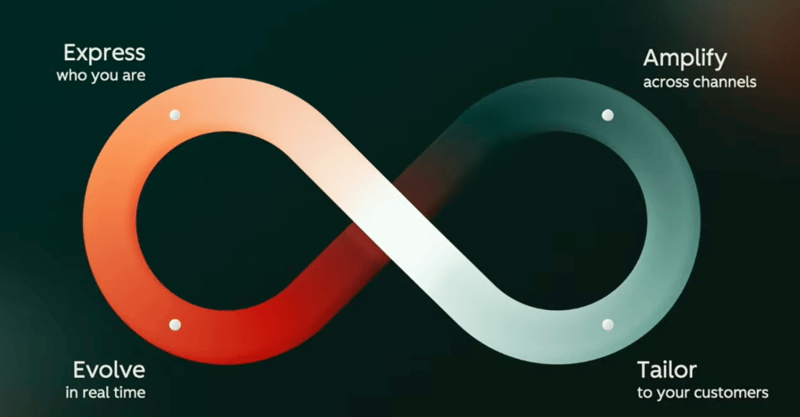
To operationalize AEO, you need a repeatable engine — not random acts of content.
We’ll use HubSpot’s updated framework:
1. Express – define your ICP and brand guidelines for AI. Capture real expertise, live if possible2. Tailor – Transform that raw material into structured, optimized assets
3. Amplify – Distribute across channels where humans and AI will encounter it
4. Evolve – Learn from performance and AI behavior, then refine
Let’s break those down.
Express: Capture Reality First
Instead of staring at a blank document and asking AI to “write a blog about X,” start by capturing real expertise:
1. A live webinar or workshop (external or internal)2. A recorded client presentation or QBR
3. An internal training session
4. A roundtable discussion with your subject-matter experts
5. Add ICP and brand guidelines for AI to personalize content and make it sound like your brand (give examples of past blogs, slides and transcripts)
The goal is to get:
1. Genuine explanations2. Real examples and anecdotes
3. Unscripted Q&A
All of these signal “human” to both your audience and to AI. After you’ve gathered these recordings, create a transcript (from Zoom, Wistia, HubSpot, etc.). The transcript becomes the raw material AI can reliably work from.
Tailor: Turn Raw Content Into Structured Assets
Once you have a transcript, feed it into AI to shape and repurpose that real expertise into structured content. This is where AI becomes a multiplier, not a ghostwriter.
Typical “Tailor” outputs from a single session:
1. One long-form guide or blog2. 3–5 shorter, question-driven blog posts
3. 10–20 social clips and posts
4. 1–2 email sequences or nurture flows
5. Updated FAQs and support articles
6. Internal enablement content for sales
Once the core content is shaped, you:
1. Apply AEO-friendly structure (clear H2 questions, concise answers, FAQs, data callouts)2. Add schema and entities
3. Refine for StoryBrand clarity and TAYA transparency
Amplify: Distribute and Connect
Publishing to your blog is just step one. Amplify your reach by:
1. Posting video clips on LinkedIn, YouTube, and other relevant platforms2. Embedding full recordings on a central resources or “show” page (we recommend Wistia Channels)
3. Sending recaps to your email list with clear CTAs
4. Connecting posts into topic clusters and internal linking paths
5. Making sure your HubSpot tracking and attribution capture AI referrals and related engagement
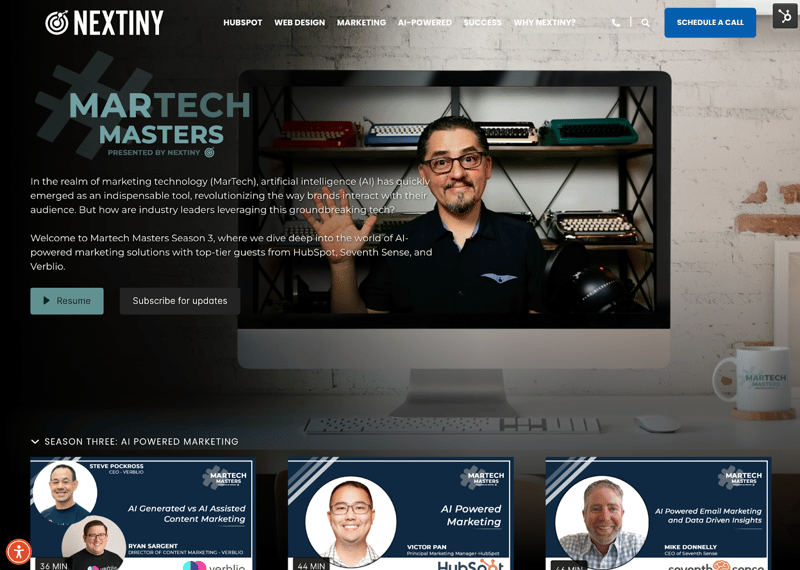
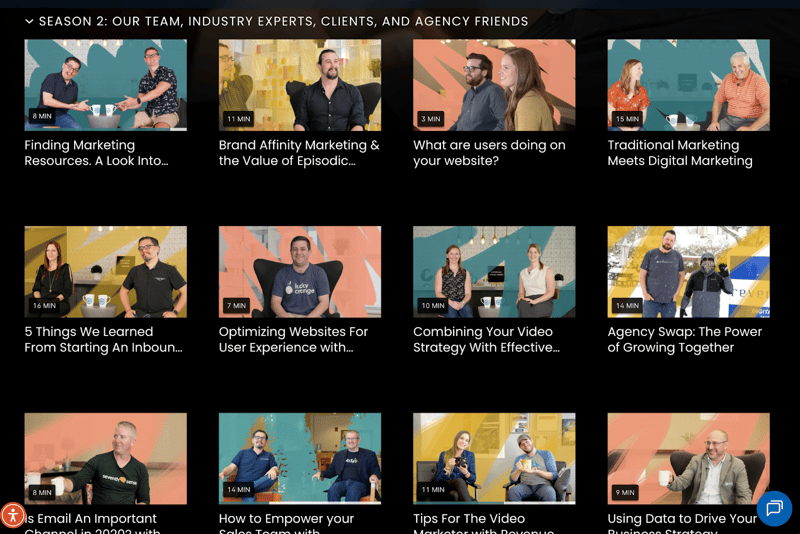
This distribution builds the multi-channel signals that both humans and AI use to judge your relevance and credibility.
Evolve: Learn, Iterate, and Compound
Finally, use data and AI feedback loops to continually refine:
1. Which topics drive not just traffic, but opportunities and revenue2. Which AI tools are sending you referrals (via HubSpot’s new AEO reporting)
3. How AI tools describe your brand today — and where they’re missing important context
4. Which formats (webinars, blog series, playbooks) resonate most with your ICPs
Then feed those insights back into the next Express → Tailor → Amplify cycle.
That’s how your AEO engine compounds over time.
Related Article: HubSpot’s New Playbook: The Loop, a Smart CRM, and AI Agents Built for Hybrid Teams [INBOUND25]
How Do You Build a Content Engine for AEO?
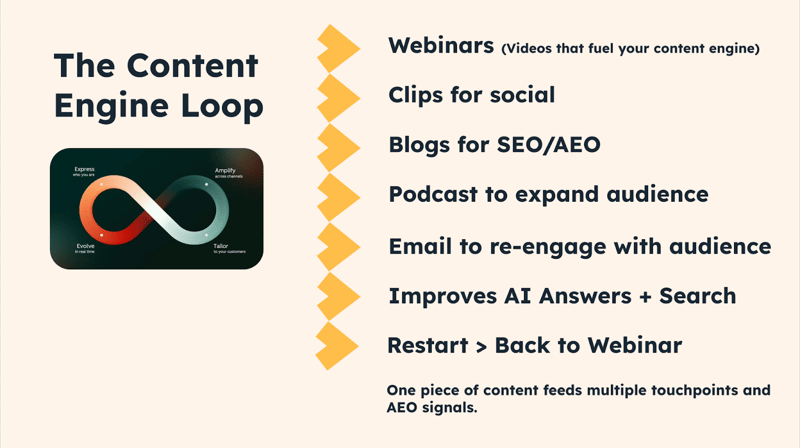
(Webinars → Clips → Blogs → Social → AI)
Let’s zoom in on one especially effective loop you’re already running:
Webinar series → Clips → Blogs → Social → AI visibility
Here’s how it works in practice:
- Choose timely questions your ICP actually cares about
- Invite prospects, customers, and partners
- Record everything (video + chat Q&A)
2. Turn the webinar into a “hero” blog or guide
- Transcribe the session
- Use AI to structure it into a long-form article (like this guide)
- Add entities, FAQs, data, and clear CTAs
3. Slice content into clips and derivative posts
- Short videos for LinkedIn, YouTube, or Shorts/Reels
- Topic-specific blog posts answering individual attendee questions
- Slide carousels or visual frameworks illustrating key ideas
4. Distribute across channels & HubSpot
- Publish to your blog, landing pages, and resource center
- Push clips and recaps via email and social
- Embed videos with transcripts so AI can read them
- Use content to promote next webinars
5. Improve AI & SEO visibility
- Over time, AI tools start citing your pages and videos as answers
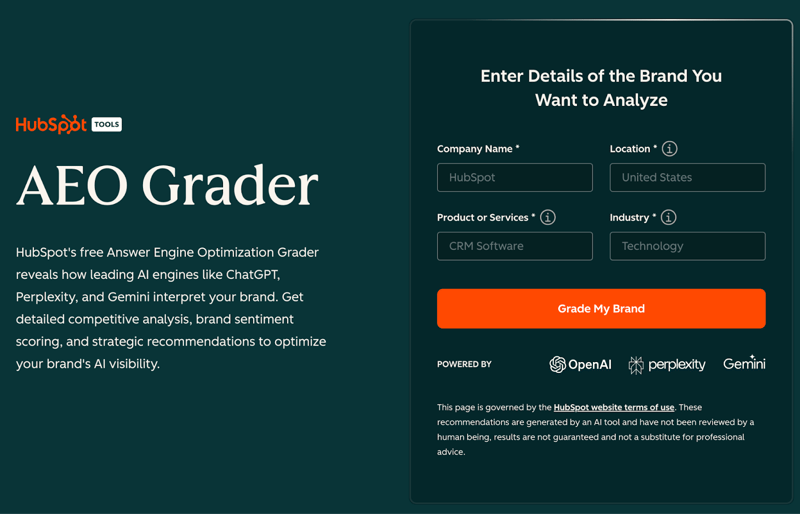
- HubSpot’s AEO Grader, HubSpot’s new “AI referrals” source, and the new AEO Strategy tool (HubSpot Content Hub) help you see where you’re winning and where you need more coverage
6. Repeat with the next webinar
-
Each new session feeds this loop again
-
Your content library, brand affinity, and AEO footprint grow together
-
The key is consistency. A single webinar is helpful; a series becomes a signature content engine for both humans and AI.
Related Article: From SEO to AEO: Optimizing Your Content Engine with Video, Webinars & Podcasts
How Should You Structure Content for AI Search Engines?
Even though this piece will live as a PDF, your supporting blogs and pages should be structured so that both readers and AI can quickly extract value.
Here’s a practical structure that’s working well right now:
1. Clear, specific title- Reflect a real question or outcome (“How to…” “What is…” “X vs Y…”)
- In 2–4 sentences, answer the main question directly
- Include key entities (who you are, who it’s for, what you’ll cover)
3. Optional embedded video with transcript
- Feature a 3–10 minute clip or full webinar segment
- Host it on a platform where transcripts are accessible (e.g., Wistia with LLM-optimized embed, YouTube with full captions)
4. Body sections framed as questions (H2s)
- Example H2s:
- “What is AEO and how is it different from SEO?”
- “Why are AI-qualified leads more likely to close?”
- Each H2 states the question clearly
5. Short, direct answer paragraphs under each H2
- 1–2 concise paragraphs that answer the question in plain language
- Follow with supporting bullets, examples, or stats when helpful
6. Inline data, examples, and stories
- Call out numbers (e.g., 60% zero-click searches, 57–70% self-education) with brief explanations and links
- Add real client or internal anecdotes to prove the point
7. FAQ section
- 3–6 FAQs at the end of the article
- Use schema to tag them as FAQPage for AI
8. Author bio and entity links
- Short author bio with headshot and expertise
- Mention your company, role, and areas of specialization
This doesn’t mean every blog must look identical, but aligning your top 10–20 strategic pieces to this structure gives AI and Google a consistent, machine-readable pattern.
How Can HubSpot Help With Answer Engine Optimization?
If you’re on HubSpot, you have a growing toolkit that aligns well with this new reality.
AEO Grader & AEO Strategy Tools
HubSpot’s AEO Grader and upcoming AEO Strategy experience help you:
- See how and where AI tools currently reference your brand
- Identify gaps in your entity coverage (services, industries, locations)
- Understand which pages are most likely to be cited in AI answers
- Prioritize content updates and net-new assets
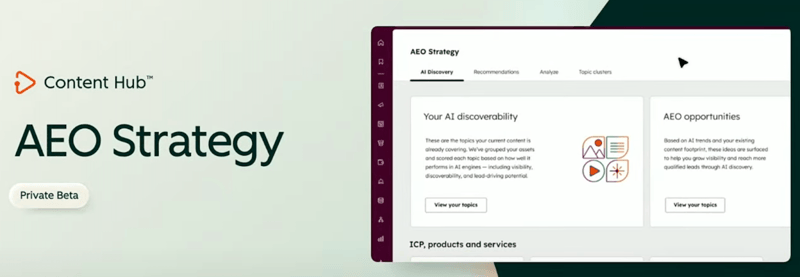
This turns AEO from a fuzzy concept into a concrete backlog your team can execute against.
HubSpot AI Copilot
HubSpot AI Copilot is an in-platform assistant that brings AI support directly into your CRM workflows. Copilot can multiply your team’s output without replacing their judgment:
- Summarize long calls and webinars into notes and next steps
- Draft follow-up emails tailored to contact history and website behavior
- Help structure blog drafts and outlines based on existing assets
- Provide pre-meeting insights that summarize what an AI-qualified buyer has already done and read
Because Copilot works with your own CRM data, it can generate context-aware content that generic tools like ChatGPT alone can’t.
HubSpot Agents (and Breeze)
Agents are AI “doers” that can take action on top of your HubSpot data and tools:
- Qualify leads based on behavior, fit, and engagement patterns
- Monitor AI-referral traffic and flag promising accounts
- Keep outreach and follow-ups consistent so busy, AI-qualified buyers don’t fall through the cracks
- Help sales reps prioritize the next best actions across their pipeline
Used wisely, Agents and tools like Breeze can help you adapt to the new sales reality where:
- Buyers are busier and more distracted than ever
- Deals often require dozens of touches over weeks or even months
- A highly qualified lead might unsubscribe from one email and still be genuinely interested
AEO gets the right people to your doorstep. HubSpot’s AI tools help you welcome them properly at scale.
Why Human Expertise Matters More in AI Search
Amid all the talk of AI, schema, and entities, it’s easy to miss the most important point:
Humans don’t buy from brands. Humans buy from humans.
AI can:
- Draft copy
- Summarize meetings
- Surface patterns in data
But it can’t:
- Sit across from a stressed CMO and help them make a career-defining decision
- Understand your buyer’s internal politics and history
- Take accountability for outcomes
The more commoditized content becomes, the more valuable human connection becomes.
In practice, that means:
- Be transparent. Talk honestly about your pricing, your limitations, and your failures (TAYA).
- Be visible. Put your people on camera, on webinars, and on stage. Let prospects see and hear the humans behind the brand.
- Be patient. Understand that buyers might reschedule three times, go dark for a month, then re-engage when internal chaos subsides.
- Be consistent. Keep showing up with helpful content, not just pitches.
In a world where AI can generate endless synthetic noise, your real expertise, real stories, and real care are the ultimate ranking signals — for both algorithms and the humans they serve.
How to Start Answer Engine Optimization: A 30-Day AEO Plan
You don’t need a 200-item backlog to start. Here’s a focused 30-day plan you can hand to your team.
Week 1: Get your bearings
- Identify your top 3 ICPs (ideal customer profiles) and their biggest questions
- List your top 10 “money pages” (pages that influence pipeline and revenue today)
- Run your brand link through HubSpot’s AEO Grader and note gaps
- Ask AI tools directly:
- “What do you know about [your company]?”
- “Which companies help with [your core service]?”
- “Does [your company] specialize in [key offering/vertical]?”
Document where AI is already mentioning you and where it isn’t.
Week 2: Capture and convert real expertise
- Host a webinar, internal training, or customer Q&A on one high-stakes topic
- Record it; generate a full transcript
- Use AI to turn that transcript into:
- One long-form blog or guide
- One short, focused blog answering a single critical question
- Structure these pieces with clear questions, concise answers, and FAQs
Week 3: Add structure, entities, and schema
For your top 5–10 existing blogs or pages:
- Add a TL;DR summary at the top (60–80 words)
- Convert subheadings into question-style H2s where appropriate
- Add a 3–5 question FAQ section at the bottom
- Use AI to generate the corresponding FAQ schema
- Ensure your footer has consistent NAP + key entities (industries, services, locations)
- Update author bios to clearly describe expertise and link to social profiles
Week 4: Test, measure, and plan next
- Use HubSpot reports to monitor:
- AI referral traffic
- Engagement with your new AEO-optimized content
- Down-funnel impact (meetings, opportunities, deals)
- Re-check AI tools with the same discovery questions from Week 1
- Note any new mentions or improved descriptions of your brand
- Prioritize your next 3 topics for the Loop Marketing Framework and schedule your next webinars or content sessions
Repeat this cycle monthly, and your AEO footprint should grow steadily, along with the volume and quality of AI-qualified opportunities.
How to Build and Improve Your AEO Strategy Over Time
You don’t have to transform everything at once. But you do need to start moving.
Here’s how Nextiny and HubSpot can help you accelerate:
1. Request an AEO Audit
Get a focused, practical assessment of:
- How AI currently “sees” your brand and content
- Where your entities, schema, and structured content are strong or weak
- Which pages and topics to prioritize for AEO and revenue impact
- A concrete 30–90 day roadmap tailored to your ICPs and HubSpot setup
2. Join the HubSpot User Group (HUG) Community
This guide grew out of a live webinar series, and the conversation is still ongoing.
- Learn from real experiments, not theory
- See how other teams are using HubSpot’s AI tools
- Bring your own questions and use cases
Links:
- Content Hub for Marketers HubSpot User Group (Website, SEO/AEO, and Content Strategy Webinars)
- Video HubSpot User Group (Video Production and Video Marketing Strategy Webinars)
- Sarasota FL HubSpot User Group (HubSpot Marketing/Sales/Service Webinars)
3. Watch the Webinar Recordings
If you want to go deeper on any section of this guide:
- “From SEO to AEO: How AI Is Redefining Client Acquisition”
- “From SEO to AEO: Fewer Leads, Bigger Wins (New Sales Reality)”
- “From SEO to AEO: Blog Strategies AI Search Engines Love”
- …and upcoming sessions on video strategy, schema, HubSpot AI, and agents
Each session shows the ideas in this guide in action — including real portal data, workflows, and examples.
Final Thoughts
AI is not here to replace your marketing team or your sales team. It is here to replace generic content, lazy SEO, and shallow funnels.
If you build a content engine grounded in They Ask, You Answer, clarified by StoryBrand, amplified by Brand Affinity Marketing, and operationalized through AEO and HubSpot’s AI tools, you’ll be positioned not just to survive this shift, but to lead in it.
The future isn’t about generating more leads. It’s about creating bigger wins. It’s about showing up more human and more helpful, supported by smarter AI and a stronger engine. That’s the opportunity in front of you.
Related Article: How to Use HubSpot, StoryBrand, and They Ask You Answer for Marketing Success